
 Newsletter
 Shop
Shop Login
Login Menü
Menü





 4/2026
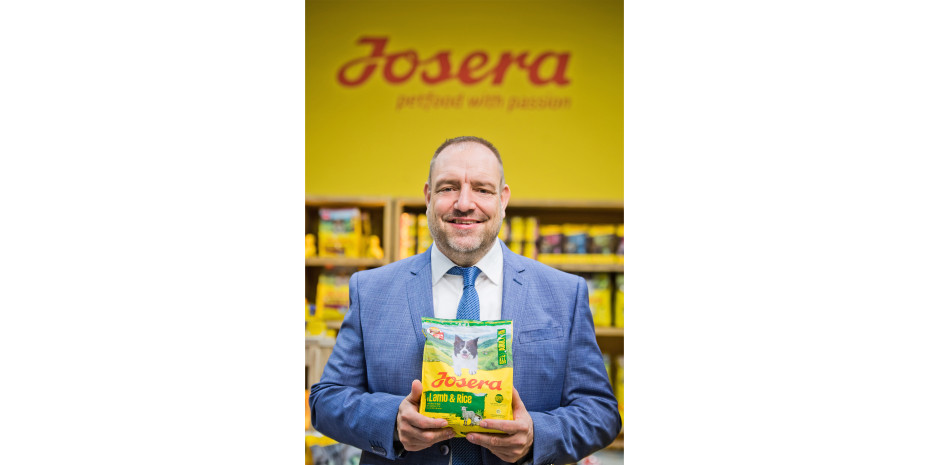
Milestones in Josera’s history, the company’s development in Germany and across Europe, right through to a market comparison, and the changing demands of pet owners – these topics and more were covered in the conversation between pet editor Sarah Daubert and Stephan Hoose, CEO of Josera Petfood and a member of the leadership board for sales & markets at Erbacher the food family.
Which development at Josera has impressed you most personally?
What has impressed me most is that we’ve gone from being a small German company to becoming an international enterprise. And that we’ve managed to evolve from a company specialising solely in dry food to a supplier of wet and dry food as well as snacks – for dogs and cats. In doing so, we’re following our vision of becoming a leading international brand. To achieve this, you need not only the right product categories, but also the right products for each range.
What events would you describe as the key milestones?
Definitely the opening of the factory in Poland last year. When I started at Josera ten years ago, we’d just opened the new factory in Kleinheubach. That was certainly exciting, but the second factory, now in Nowy Tomyśl (Poland), is even more exciting.
Another key milestone was our international expansion: we’ve been in Poland since 1998 and in Ukraine since 2007. Tanzania has been our second-newest project for about six years. We’ve also recently set up a hub in Singapore to establish a presence in Asia. Our aim is to build a strong long-term market position in selected growth markets and to be close to local pet parents. Otherwise, we’re working with many countries that wish to trade and aim to establish ourselves there. Brazil, India and China are of less interest to us, as these markets are highly volatile: you might be doing well there today, but that could change tomorrow.
What are the next concrete steps for Josera?
We have selected a number of focus countries in Europe where we are specifically building up our local teams. We are trying to do the same in other countries outside Europe where we want to gain a foothold.
We’re also continuing to work on our product range. We already have a good range of wet food, and we don’t need to tweak the dry food just yet – but we do need to focus all the more on snacks.
The next step will be a relaunch of our cat products shortly – these products have had the same design for over ten years. Our Josi brand is also getting a ‘nice new look’ – but it’s definitely staying yellow!
Can the European markets be compared with one another?
For the brand relaunch of Green Petfood and Josera, we looked very closely at end-customer behaviour. To this end, we collaborated with renowned firms that analyse this consumer behaviour not only through questionnaires but also through face-to-face interviews. In Germany and Poland, we surveyed 100 people in each country, whilst in Asia we covered three countries. The market researchers’ recommendation was not to include Africa and the Americas, as these regions behave in exactly the same way as Europe – apart from minimal differences, the picture is the same.
For pet parents, one thing matters above all else in the end: the visible well-being of their pet. And this need is the same worldwide.
Animals cannot tell us what they need. That is why pet parents pay particular attention to factors such as vitality, energy and taste to ensure that their pets are thriving. Our job is to provide the animals with the nutrients they need to achieve this.
How do you assess the current overall trend in the German pet market?
Unlike with cats, the number of households with dogs is stagnating, or rather, it is on the decline. This trend has been emerging for the past two to three years. I believe that, overall, we will see an increase in the number of pets, perhaps because people are re-prioritising their lives. People tend to live alone or with a partner, and then a cat or a dog joins the household. This applies across the whole of Europe; the individual countries are following a relatively similar pattern. Of course, there are regional differences: in countries such as Spain, dogs are still more popular than cats. That balances things out somewhat for us as an internationally active manufacturer.
Everyone’s talking about premiumisation – but what does that mean for the market?
We offer brands in every price segment: from entry-level through to premium and right up to the super-premium segment. The end customer chooses the product that best suits their pet’s needs. Generally speaking, however, people only cut back on spending on their pets as a very last resort, which is why I still see the trend moving towards super-premium. If someone wants to save money, dry food is of course always a good choice. Our job is to fulfil the wishes of pet parents. And we do that with our diverse range of brands.








 Newsletter