 Newsletter
 Shop
Shop Login
Login Menü
Menü



 1/2026
Keeping contents fresh for long periods, protecting them during transport, conveying brand identity, meeting legal requirements – and doing all this in a sustainable and economical way. The trend towards humanising pets is also having an impact on nutrition. People have similar expectations for their pets’ food as they do for their own: healthy, resource-efficient – and sustainable throughout the entire supply chain.
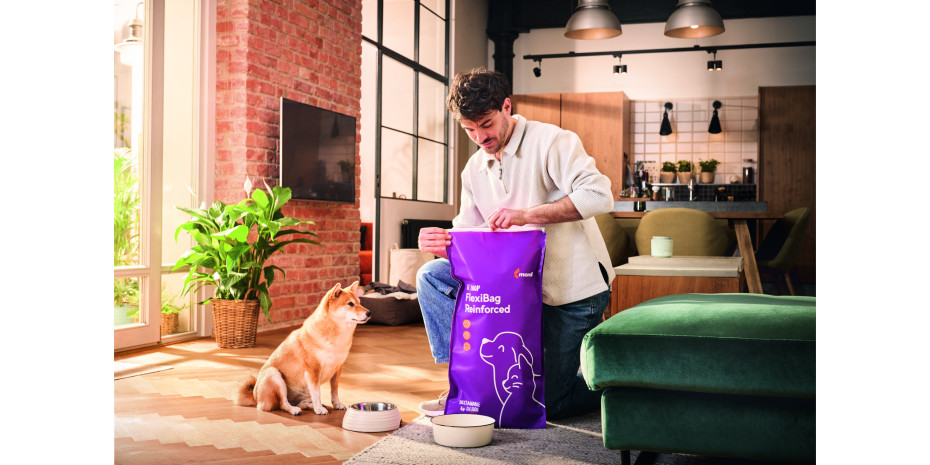
Not only procurement and production, but also transport, packaging and the shelf life of wet and dry food play a decisive role. Individual characteristics make choosing the ideal packaging material for pet food particularly challenging: the wide variety of formats (from single portions to large feed bags), but also the requirements for shelf life, waste reduction and recyclability.
‘As Europe’s leading manufacturer of pet food packaging, we successfully pursue a material-neutral approach,’ explains Damien Maisonnial, Business Development Manager Pet Food, Mondi Consumer Flexibles. ‘Thanks to our broad portfolio of paper-based, plastic-based and hybrid materials and our variety of packaging formats, we are equipped to meet every packaging requirement, whether for dry food, wet food or treats.’
Pet food and its packaging requirements
Dog snacks, wet cat food and similar products place high demands on the barrier function of the packaging material. Without a reliable barrier, the material can become greasy or moisture can penetrate and impair the shelf life of the contents. The choice of material is therefore crucial.
Packaging undergoes a real stress test during the sterilisation and pasteurisation of wet food. The food is preserved by heating – either by pasteurisation at 70 to 100 °C or by sterilisation in autoclaves at over 120 °C.
Animal feed packaging is also exposed to mechanical stress during transport, storage and everyday use. The material must therefore be sufficiently durable. In addition, there are visual elements to consider. Printing inks must be abrasion-resistant so that logos, product information and decorations remain legible even with intensive use. Furthermore, the often high humidity in storage and sales environments, as well as direct contact with grease or oils, requires durable printing processes that neither run nor fade. Machine compatibility also plays an important role. This can be ensured through close cooperation between the feed and packaging manufacturers.
Not all recycling is the same
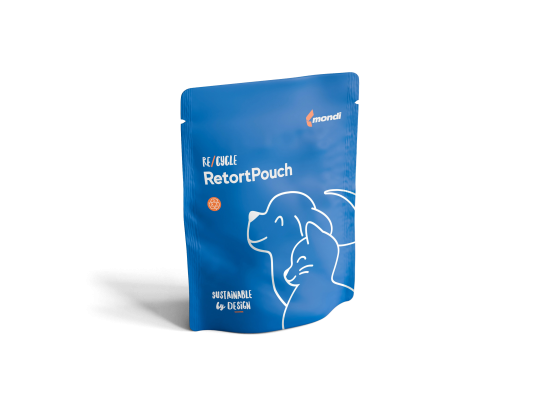
From a sustainability perspective, the ‘supreme discipline’ in plastic packaging is to use mono-materials that facilitate single-type recycling later on. ‘Technical advances now make it possible to achieve extensive barrier functions even with packaging made from monomaterials,’ explains Maisonnial. ‘This makes recycling possible and allows valuable materials to remain in the cycle.’
Heavy weight – no burden
Large packages for dry food – such as bags containing several kilograms – often offer cost-conscious consumers attractive value for money, but they are not trivial in terms of packaging and logistics. The advantage of sustainable primary packaging can be negated if it requires additional outer cartons or protective film for shipping. That is why it is important to have a well-thought-out design that saves material but still ensures stability.
Sustainable and durable
Innovative packaging solutions for pet food are no longer a dream of the future for Mondi, but a reality, as proven by the success story of its mono-material retort stand-up pouches. ’Around 28,000 tonnes of wet pet food are packaged in Europe every year using our innovative retort stand-up pouches. That’s enough to feed more than seven million cats,‘ says Maisonnial. ’This is made possible by our backward-integrated value chain and extensive production network – from in-house film production and finishing to the packaging of stand-up pouches, we cover every step of the value chain.’
Health, price awareness, sustainability and convenience – these trends promise to continue shaping the pet food landscape in the future. The right packaging is a key ally for pet food manufacturers on many levels: it not only makes fulfilled customer expectations tangible, but also makes a real contribution to recyclability and sustainability.
PPWR
The European Packaging and Packaging Waste Regulation (PPWR), which came into force on 11 February 2025, also imposes stricter requirements on pet food packaging:
• From 2026, new limits for polyfluorinated alkyl substances (PFAS) will apply to packaging that comes into contact with food.
• From January 2030, only packaging that is recyclable may be placed on the market. All other packaging will be excluded from the EU market or banned.
• From 2030, minimum proportions of recycled materials will be required for plastic packaging. For contact-sensitive packaging that is not made of PET, the required proportion of recycled material is 10 per cent.
• Packaging should be designed in such a way that weight and volume are reduced to the necessary minimum.






 Newsletter