
 Newsletter
 Shop
Shop Login
Login Menü
Menü





 03/2026

- Retailers and suppliers: exclusive insights
- Market analyses and country reports
- Magazine in print and digital
- Latest news and archive
The European pet food industry generated sales of approximately €29.4 billion in 2024, with a production volume of around 8.6 million tonnes, according to the latest Facts & Figures published in Fediaf’s Annual Report 2026. The figures, compiled with external data experts at Soulor Consulting and supplied by all 15 national association members, show value growth of 4% and overall industry growth of 1%. In line with Fediaf’s established methodology, the data refers to 2024, published two years after collection.
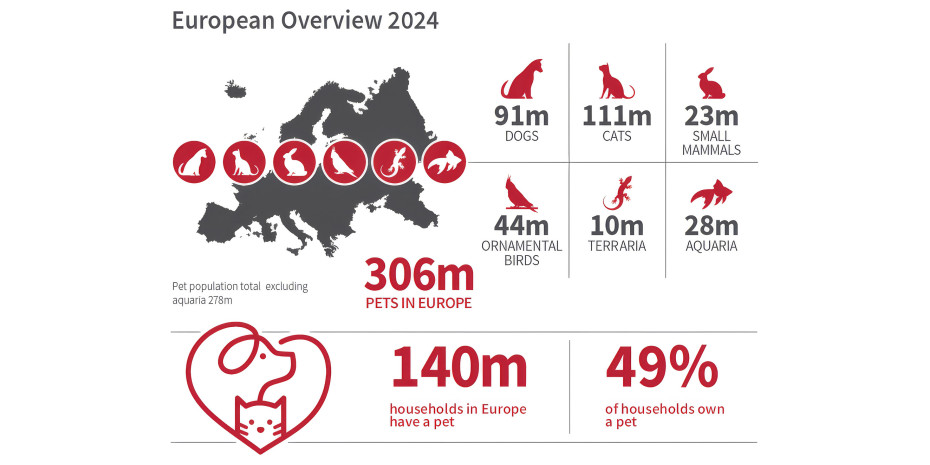
Europe is now home to 306 million pets across 140 million households — meaning 49% of all European households keep at least one pet. Excluding aquaria, the total pet population stands at 278 million. The figures cover 41 of the 48 Council of Europe member states; Russia is no longer included, and a number of additional countries have been incorporated. Fediaf therefore advises against direct year-on-year comparisons.
Cats remain the most populous companion animal, with 111 million across Europe, ahead of 91 million dogs. They are followed by 44 million ornamental birds, 28 million aquaria, 23 million small mammals and 10 million terraria. The industry counts more than 400 pet food companies.
A look at the format split underlines the continuing divergence between volume and value. While 58% of pet food produced by volume is for dogs and 41% for cats, in value terms the cat sector accounts for 50% against the dog sector’s 46% — a reflection of the higher share of wet food in feline diets.
The breakdown by format shows distinct feeding patterns. In the dog segment, dry food dominates volume at 60%, with wet food at 30% and treats at 10%; by value the picture shifts to 50% dry, 23% wet and a notable 27% from treats. For cats, wet food leads by volume at 61%, ahead of 36% dry and 3% treats, while by value wet food contributes 60%, dry 31% and treats 9%.
National data reveals considerable variation in pet-keeping habits. Spain records the highest household ownership rates, with 70% of households owning at least one dog and 56% at least one cat, followed by Poland (52% dogs, 42% cats) and Hungary (50% dogs, 34% cats).







 Newsletter