 Newsletter
 Shop
Shop Login
Login Menü
Menü





 2/2026

- Retailers and suppliers: exclusive insights
- Market analyses and country reports
- Magazine in print and digital
- Latest news and archive
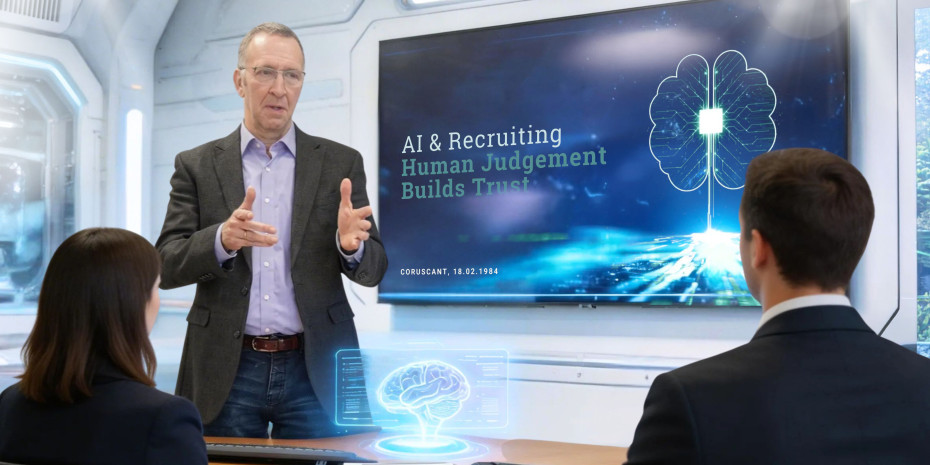
Artificial intelligence is reshaping recruiting across Europe at remarkable speed. Candidates routinely use generative AI to structure applications, refine language, and prepare for interviews. Companies increasingly deploy AI-powered systems to analyze résumés, accelerate sourcing, and prioritize large applicant pools efficiently.
The productivity gains are undeniable – and they will continue to expand.
Yet as recruiting becomes more technology-driven, one element grows in strategic importance: the human factor.
AI as an assistive system – not a decision authority
AI tools are powerful. They can structure information, compare profiles, identify patterns, and significantly increase administrative efficiency. What they cannot do – and must not do – is assume responsibility.
Recruiting is not a technical sorting exercise. It is a business-critical investment decision with long-term consequences for leadership quality, cultural alignment, and corporate reputation.
AI must therefore remain what it is designed to be: an assistive system. It can provide analytical input, improve transparency, and support structured comparison. The final judgment – assessing potential, cultural fit, leadership capability, and long-term contribution – must remain a human responsibility.
Without clearly defined accountability and transparent evaluation criteria, organizations risk adopting algorithmic recommendations uncritically. This not only undermines decision quality but also weakens trust – internally and externally.
Europe’s regulatory reality: compliance as competitive discipline
In Europe, the conversation around AI in recruiting cannot be separated from regulation. With the EU AI Act entering into force on August 1, 2024, and becoming fully applicable from August 2, 2026, the use of AI in employment-related contexts is no longer experimental. It is regulated.
For organizations operating in or with the European Union, this fundamentally changes the playing field. Transparency, documentation, risk assessment, and meaningful human oversight are not optional. They are legal obligations.
Talent acquisition is therefore evolving beyond a functional HR process. It is becoming a compliance-relevant management discipline. Companies must be able to demonstrate how AI-supported decisions are made, how data is processed, and how potential discrimination risks are identified and mitigated.
The responsibility does not end with the software provider. The organization deploying AI remains…






 Newsletter